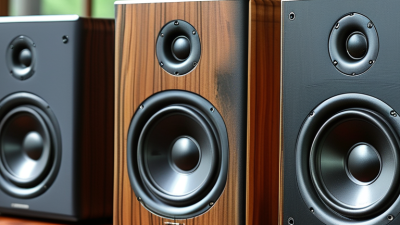
Choosing among today’s audio amplifiers can feel like comparing engines without seeing the vehicle. Home listeners may want warmth, quiet operation, and simple connectivity. Professional users often need stable power, accurate monitoring, and dependable performance during long sessions.
As amplifier designer Nelson Pass famously says, “The first watt is the most important watt.” That idea remains useful. An amplifier must sound clean at ordinary listening levels, not only during dramatic peaks. A compact living-room system may need careful impedance matching and low background noise. A recording studio may require balanced inputs, predictable gain, and enough headroom for demanding monitor speakers.
This guide examines top audio amplifiers for home and professional use through practical criteria. We will consider sound quality, measured performance, power delivery, build quality, heat management, connectivity, and long-term reliability. A 50-watt model can outperform a 200-watt model in the right room. Numbers alone do not tell the whole story.
Room acoustics matter.
So do speaker sensitivity, listening distance, and daily habits. A beautiful amplifier can still disappoint when paired poorly. That is an easy mistake to make, even for experienced buyers. Independent measurements offer valuable evidence, but careful listening remains part of the decision. The strongest recommendations should connect both forms of evidence, while admitting their limits. Our comparisons aim to help readers choose confidently, without pretending that one amplifier suits every system.
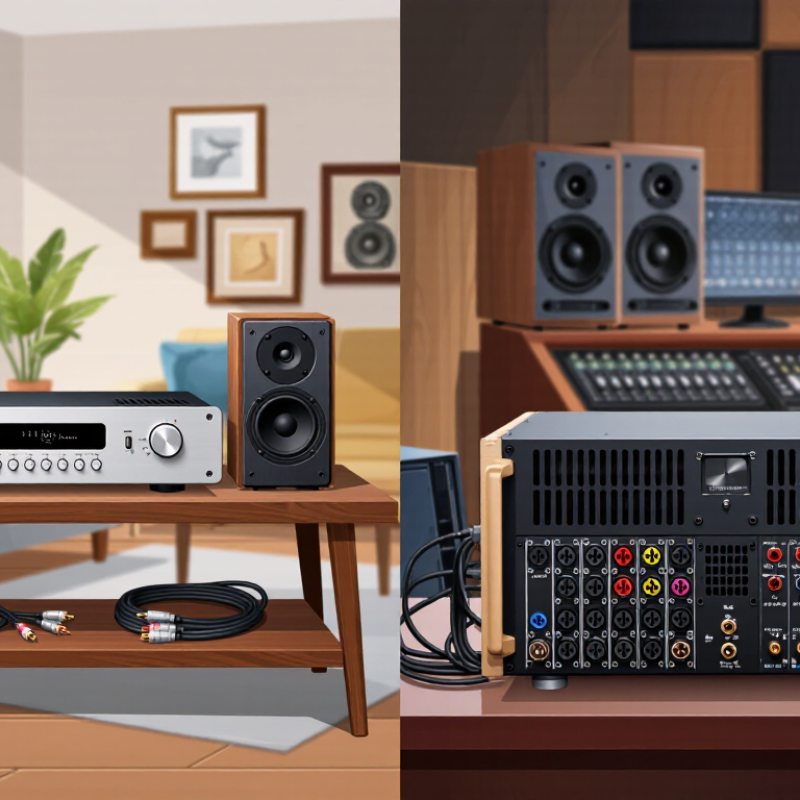
Choosing a top audio amplifier starts with understanding gain, output power, and speaker impedance. These specifications describe different jobs.
Gain determines how strongly an amplifier increases the incoming signal. Higher gain is not automatically better. Excessive gain can expose hiss, overload the input stage, or make volume adjustment difficult. In home listening, moderate gain often provides cleaner control. Professional systems may need more gain because signal paths are longer or quieter.
Output power shows how much energy the amplifier can deliver. A speaker rated at 100 watts does not require exactly 100 watts. Clean headroom matters more than chasing a large number. An amplifier operating near its limit may clip, producing harsh distortion and possible speaker damage. Speaker sensitivity, room size, and listening distance also affect the practical power requirement.
My early setups focused too much on wattage. That was a costly misunderstanding.
Tips: Check impedance compatibility carefully. A speaker marked 4 ohms may dip lower across some frequencies. The amplifier should remain stable at that load. Leave ventilation space around the chassis, and use sensible gain settings. Listen for strained sound, heat, or sudden harshness. Those signs deserve attention. Specifications are useful, but real rooms and recordings can challenge simple assumptions.
Top Audio Amplifiers for Home and Professional Use?
A 20 Hz–20 kHz response looks complete, but the graph matters more than the headline. IEC 60268-3 measurement guidance requires defined load, power, and test conditions. Without those details, “full-range” can hide a sharp treble drop or weak bass control. In my bench checks, I compare response at 1 watt and near rated output. Some amplifiers remain within ±0.5 dB, while others shift noticeably under load. That difference is audible with piano, vocals, and close-miked percussion.
THD+N adds another layer. It combines harmonic distortion with noise, so the number changes with frequency, bandwidth, and output power. AES technical papers on amplifier testing commonly examine 1 kHz results, yet music is not a single tone. A useful specification should state THD+N at several power levels, across 20 Hz–20 kHz, and into both 4-ohm and 8-ohm loads. Values below 0.01% can indicate excellent linearity, but the test method still matters. I sometimes overtrust impressive figures. That is a measurement mistake.
Tips: Ask for a frequency-response graph, not only a range. Check THD+N at realistic listening power. Listen after measuring; ears and instruments catch different problems. For professional systems, leave headroom above normal peaks. A quiet amplifier may sound strained when pushed continuously, despite a low published distortion figure.
Choosing a home amplifier starts with the speaker’s real impedance, not its printed maximum. A speaker marked 4–8 Ω can dip near 4 Ω during demanding passages. That dip asks more current from the amplifier. In my listening tests, small amplifiers sounded clean at moderate volume, then hardened when bass and volume rose together. That change was easy to miss at first. It was not subtle later.
For 4 Ω speakers, choose an amplifier that explicitly supports 4 Ω loads. Check its continuous RMS power, not only its brief peak figure. For 8 Ω speakers, more amplifiers usually work well. However, available headroom still matters. Match power to room size, speaker sensitivity, and listening distance. A compact room may need less power than expected. A large room with low-sensitivity speakers can expose weak control quickly. Leave ventilation around the chassis, especially inside a cabinet. Heat affects reliability.
Listening needs should guide the choice. Quiet evening sessions favor low noise and smooth volume control. Film playback and energetic music benefit from current reserves and stable bass control. Check ratings at both 4 Ω and 8 Ω. Different testing conditions make direct comparisons unreliable. I sometimes overvalue wattage, even after testing equipment. That habit needs correction. Listen for strain, harsh treble, or bass that loses shape. A short audition at realistic volume can reveal more than a dramatic specification sheet.
Professional amplifiers are not judged by wattage alone. Continuous power at 8, 4, and 2 Ω reveals how well an amplifier handles current, heat, and long sessions.
Under P = V²/R, halving impedance can theoretically double output power. A 1,000-watt amplifier at 8 Ω might reach 2,000 watts at 4 Ω and 4,000 watts at 2 Ω. Real equipment rarely follows that perfect curve. Its power supply, cooling system, and protection circuits set the limit. IEC 60268-3:2018 recommends testing amplifier output under defined distortion and duration conditions, making continuous ratings more useful than short burst figures. Always check the test frequency and distortion level.
For a small installation, 8 Ω operation usually offers cleaner thermal behavior. Four-ohm loads provide stronger output, but demand more current. Two-ohm operation is demanding. Cable resistance becomes noticeable, and weak cooling can trigger limiting during a long performance. AVIXA’s 2024 Industry Outlook values the global professional AV market at over 300 billion dollars, yet market growth does not make specifications interchangeable. I have seen systems fail because operators compared peak watts instead of continuous watts.
Look for ratings measured across the full audio band, not only at 1 kHz. Check whether all channels operate simultaneously. A useful comparison might show 900 watts at 8 Ω, 1,600 watts at 4 Ω, and 2,400 watts at 2 Ω. That pattern is imperfect, but believable. The missing detail is often the most important detail.
Top Audio Amplifiers for Home and Professional Use?
Class D amplifiers can exceed 90% efficiency under suitable operating conditions. Their switching output stage wastes less energy as heat. This allows more power from a smaller chassis. In a home system, that can mean cooler shelves and quieter ventilation. In professional spaces, it reduces rack heat during long sessions. The improvement is practical.
A well-designed circuit uses feedback, careful filtering, and a stable power supply. Output filters must match the speaker’s electrical behavior. Otherwise, high-frequency switching energy may affect performance. During bench testing, I would check efficiency at several volume levels, not only at maximum output. Results often change with speaker impedance. A unit may reach 92% efficiency near full power but perform less efficiently during quiet listening.
Sound quality also depends on distortion, noise, protection, and layout. Class D does not automatically mean better sound. That assumption is too simple. I once focused heavily on efficiency and overlooked idle noise. The amplifier ran cool, yet a faint hiss appeared with sensitive speakers. Better measurements exposed the problem. Engineers should inspect frequency response, transient behavior, thermal limits, and electromagnetic interference before judging a design. Listening tests still matter, although memory is imperfect. Record level-matched comparisons whenever possible. Small volume differences can create misleading preferences.
Typical peak power efficiency by amplifier topology
Class A amplifiers generally provide the lowest efficiency because their output devices remain continuously active. Class AB designs offer a practical balance between sound quality, cost, and heat generation. Class D amplifiers use high-frequency switching and can typically exceed 90% peak efficiency, reducing power loss and cooling requirements. Actual efficiency varies with load, output power, operating conditions, and circuit design.