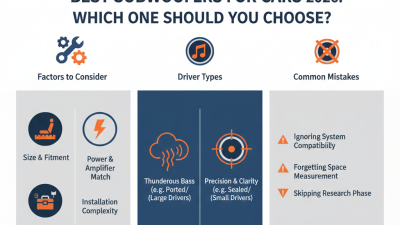
Download the 2025 Focal Car Catalogue | Focal INSIDE Catalogue | Join our Mailing List!

7 Tips for Choosing Car Audio Subwoofers?

Choosing car audio subwoofers is not simply a contest for the loudest bass. It is a careful balance between enclosure space, amplifier power, cabin size, and musical taste. A compact hatchback behaves differently from a large SUV. Even the shape of the trunk can change how low frequencies spread. This guide introduces seven practical tips for selecting a subwoofer that sounds powerful, controlled, and suitable for daily driving.

Steve Meade, a respected car audio builder and educator, often emphasizes, “A subwoofer should support the music, not replace it.” That principle matters when comparing car audio subwoofers. A 12-inch model may create deeper bass, but a smaller 8-inch unit can sound tighter in limited space. Sensitivity, impedance, RMS power, and enclosure design also deserve attention. Peak power figures can look impressive. They can also distract from more useful specifications.

Many buyers make one mistake. They choose the driver before checking the amplifier. I have seen this approach produce weak output, distorted notes, or unnecessary expense. The seven tips ahead examine power matching, sealed and ported boxes, cone materials, installation limits, sound preferences, and long-term reliability. They also question a popular assumption: bigger is not always better. Sometimes, a modest subwoofer with a properly designed enclosure delivers cleaner bass than an oversized system. Careful listening remains essential. Bass should be felt in the seat, but vocals and instruments should remain clear.
7 Tips for Choosing Car Audio Subwoofers?

Define Your Car Audio Goals and Listening Preferences

Before choosing a car audio subwoofer, define what you want to feel and hear. Do you prefer tight bass for jazz, deep rumble for electronic music, or balanced impact for daily listening? Your answer matters more than maximum power. In my installation experience, many drivers choose oversized equipment and later reduce the gain. That choice can waste space and energy.

Tip 1: Match the subwoofer to your listening habits. A sealed enclosure often produces controlled, accurate bass. A ported enclosure can sound louder and more dramatic, but it may feel less restrained. Listen to familiar tracks at moderate volume. Notice the kick drum, bass guitar, and low electronic notes.

Tip 2: Consider your vehicle and daily routine. A compact hatchback may need less air movement than a large cabin. Measure the available storage area before buying an enclosure. Check the amplifier’s continuous power rating, not only its peak figure. Electrical limits also matter, especially when headlights dim during heavy bass notes.

Tip 3: Choose comfort over impressive specifications. Excessive bass can cause listening fatigue and hide vocals. I once tuned a system too aggressively, then disliked it after a long drive. That mistake changed my method. I now adjust crossover frequency, phase, and gain using several music styles. Your preferences may change over time, so leave room for adjustment.

Match Subwoofer Size to Your Vehicle’s Available Space

Choosing a car audio subwoofer begins with measuring the space, not chasing the largest cone. Open your vehicle’s cargo area and record its width, height, and available depth. Check around wheel wells, seat brackets, and the hatch or trunk lid. A subwoofer may fit on paper but fail when the enclosure needs extra clearance.

A compact enclosure often suits a sedan with a shallow trunk. In a hatchback, a larger enclosure may fit, but it can reduce luggage space and block the rear view. I have seen drivers measure only the enclosure’s front panel and overlook its sloping back. That mistake forced a costly adjustment. Measure every side, including terminal covers and wiring space.

A sealed box usually needs less room than a ported design, although its sound and efficiency differ. Match the subwoofer’s dimensions to the enclosure specifications, then leave a small buffer for installation. Around two inches of practical clearance can prevent rattling and awkward cable bends. Small is sometimes better.

Do not ignore daily use. A family vehicle may need space for groceries, tools, or a stroller. A powerful subwoofer is not useful if it makes the cargo area unusable. Recheck the measurements with the seats folded and upright. My own early installations taught me this: available space changes with real life, not just with a tape measure.

7 Tips for Choosing Car Audio Subwoofers: Match Subwoofer Size to Your Vehicle’s Available Space

Typical cargo-space figures vary by vehicle design and trim level. Smaller vehicles generally suit compact 8–10 inch subwoofers, while sedans and SUVs can accommodate larger 12–15 inch systems. Always measure the enclosure’s external dimensions, including clearance for wiring and ventilation, before choosing a subwoofer.

Choose the Right Power Rating and Amplifier Compatibility

7 Tips for Choosing Car Audio Subwoofers

Choose the Right Power Rating and Amplifier Compatibility

A subwoofer’s RMS rating matters more than its advertised peak figure. RMS describes the power it can handle during normal, sustained use. Match the amplifier’s RMS output closely with the subwoofer’s RMS rating. A little amplifier headroom can work well when the gain is adjusted carefully. Too much power is risky. Too little power can also cause distortion when pushed hard.

Check the subwoofer’s impedance before buying. A dual voice coil model may support different wiring options. The final impedance must stay within the amplifier’s rated range. Otherwise, the amplifier may overheat or shut down. Read both instruction manuals. Do not rely on online guesses.

The enclosure changes the result. A sealed box usually gives tight, controlled bass, while a ported box can play louder around its tuned frequency. Confirm the recommended enclosure volume. I once chose a powerful subwoofer for a small box, and the bass sounded weak and strained. That mistake taught me to measure first. Set the crossover near 70–90 Hz, then adjust by ear. Keep the gain moderate. It is not a volume control. Use suitable wiring and secure connections, because poor installation can waste power and create unwanted noise.

7 Tips for Choosing Car Audio Subwoofers? - Choose the Right Power Rating and Amplifier Compatibility
Tip Key Specification Recommended Selection Why It Matters Compatibility Check Practical Buying Advice
1 Match RMS Power 250–500 W RMS for many everyday systems RMS indicates the continuous power a subwoofer is designed to handle. It is more useful for matching equipment than peak or maximum power. Choose an amplifier that can deliver approximately the subwoofer’s RMS rating at the correct load, preferably within about เดียว 75–125% of that rating. Do not select a subwoofer based only on a large peak-power number. Confirm the continuous RMS specification in the product documentation.
2 Check Amplifier Output Compare amplifier RMS output at 2 Ω or 4 Ω Amplifier power changes with impedance. An amplifier may provide more power at a lower impedance, but only if it is rated to operate safely at that load. The amplifier’s RMS output at the subwoofer’s final impedance should be clearly specified and should not exceed the subwoofer’s thermal rating by a substantial margin. Use the amplifier’s RMS figures, not its peak, dynamic, or “maximum” output claims, when planning the system.
3 Understand Voice-Coil Impedance Single voice coil or dual voice coil, commonly 2 Ω or 4 Ω Voice-coil configuration determines the wiring options and the final impedance presented to the amplifier. Verify that the planned series or parallel wiring produces a load supported by the amplifier. Never assume a dual voice-coil model can be wired to every impedance. Write down the final impedance before choosing an amplifier. A wiring diagram helps prevent an unsafe load.
4 Choose the Enclosure Type Sealed, ported, or manufacturer-specified enclosure A sealed enclosure usually provides controlled, accurate bass and needs less space. A ported enclosure can produce higher output around its tuned frequency but requires correct design and tuning. Match the enclosure’s internal volume, port dimensions, and tuning frequency to the subwoofer’s specifications. Do not place a driver in an enclosure that is too small or randomly ported. Incorrect volume or tuning can reduce performance and increase damage risk.
5 Consider Vehicle Space Common sizes: 8, 10, 12, or 15 inches Larger cones can move more air, but output also depends on excursion, enclosure design, sensitivity, and available amplifier power. Measure the available height, width, depth, mounting depth, and clearance around the enclosure before ordering. A properly installed 10-inch or 12-inch subwoofer can be a balanced choice for many vehicles without sacrificing all cargo space.
6 Review Sensitivity and Frequency Range Compare sensitivity using the same test method; typical published values may be around 82–92 dB Higher sensitivity can indicate more output from the same amplifier power, although measurement conditions vary between manufacturers. Check that the amplifier has enough clean power and that the subwoofer’s usable frequency range suits the system’s crossover settings. Use frequency-range figures as a guide rather than a guarantee. Installation, cabin acoustics, and enclosure design strongly affect actual bass response.
7 Set the Crossover and Gain Correctly Low-pass crossover commonly set near 70–100 Hz Correct adjustment blends the subwoofer with the door speakers and reduces distortion. Gain is an input-sensitivity control, not a volume boost. Use a low-pass filter, confirm polarity, avoid excessive bass boost, and set gain with a clean source signal. Begin with moderate settings and increase gradually. Audible distortion, mechanical noise, or excessive cone movement indicates that the system is being pushed too hard.

Compare Enclosure Types for Bass Response and Installation Needs

7 Tips for Choosing Car Audio Subwoofers?

Compare Enclosure Types for Bass Response and Installation Needs

Choosing a car audio subwoofer starts with the enclosure, not the speaker size. A sealed enclosure uses an airtight cabinet and delivers tight, accurate bass. It suits rock, jazz, and smaller vehicles. In my installations, sealed boxes were easier to position behind a seat. They also needed less internal space. Bass feels controlled. That matters during daily driving.

Ported enclosures add a tuned vent for louder, deeper output. They work well for electronic music and heavy low-frequency effects. However, the port requires careful tuning and clearance. A blocked vent can make bass sound weak or rough. I once fitted a ported box too close to luggage. The result was disappointing. Bandpass enclosures can sound powerful within a narrow frequency range. They usually need more space and careful design. Their impressive output may hide uneven bass.

Measure the available area before buying anything. Check height, width, depth, and trunk access. A compact sealed box may outperform a larger ported box that cannot fit correctly. Confirm the enclosure’s internal air volume matches the subwoofer’s specifications. Do not ignore the amplifier’s power and crossover settings. Excessive gain can damage equipment or create distortion. Listen from the driver’s seat, not beside the open trunk. Your first choice may still need adjustment. Car interiors change bass response more than many people expect.

Evaluate Impedance, Sensitivity, and Overall Sound Quality

7 Tips for Choosing Car Audio Subwoofers?

Impedance should match the amplifier’s safe operating range. A 2-ohm subwoofer can draw more current than a 4-ohm model. That may increase output, but it can also create heat and distortion. Check continuous RMS ratings, not exaggerated peak figures. ANSI/CTA-2031-A provides standardized methods for evaluating in-vehicle audio performance, making comparable specifications more useful. Still, specifications do not predict every cabin’s result.

Sensitivity is normally measured in decibels at 1 watt and 1 meter. Higher sensitivity often produces more volume from limited amplifier power. It does not automatically mean deeper or cleaner bass. A sealed enclosure may sound tighter, while a correctly tuned ported enclosure can deliver more low-frequency energy. Vehicle cabin gain changes the result, too. I once chose sensitivity too quickly and underestimated enclosure volume. That mistake cost both space and balance.

Overall sound quality depends on distortion, transient control, crossover integration, and installation accuracy. Grand View Research’s Automotive Audio Market Size report projects continued market growth through 2030, reflecting stronger demand for refined in-car listening, not merely louder systems. The World Health Organization’s 2021 World Report on Hearing warns that over 1 billion young people risk hearing damage from loud recreational sound. A practical test uses familiar tracks at moderate volume. Listen for muddy kick drums, rattling panels, and vocals that lose focus. Some judgment remains subjective. That is worth admitting.