Download the 2025 Focal Car Catalogue | Focal INSIDE Catalogue | Join our Mailing List!

China Best High Fidelity Speakers for Global Buyers?

Choosing China’s best high fidelity speakers for global buyers takes more than comparing prices or reading a power rating. The right choice depends on the listening space, intended use, and the supplier’s ability to deliver consistent products. A compact bookshelf speaker may suit a small apartment, while a larger room may need floor-standing models and careful placement. Even premium components can sound different when paired with another amplifier or positioned near a wall.

Start with verifiable details: frequency response, sensitivity, impedance, driver materials, cabinet construction, and warranty terms. Ask suppliers for clear product specifications, sample units, and information about production quality checks. Where relevant, confirm that documentation and labeling meet the requirements of your destination market. Listen to familiar recordings at a realistic volume. Listen closely. A polished demonstration is useful, but it cannot replace testing in your own room. That distinction is easy to miss.

Price alone rarely tells the full story. Shipping protection, lead times, communication, and after-sales support can shape the buying experience just as much as sound quality. Compare the same model across suppliers, and ask how revisions or component substitutions are handled. A specification sheet cannot capture every preference or acoustic condition, and no single test proves long-term reliability. I would treat confident claims cautiously until samples and records support them. The best decision is usually a balanced one: sound that suits your needs, construction you can inspect, and a supplier willing to answer specific questions.
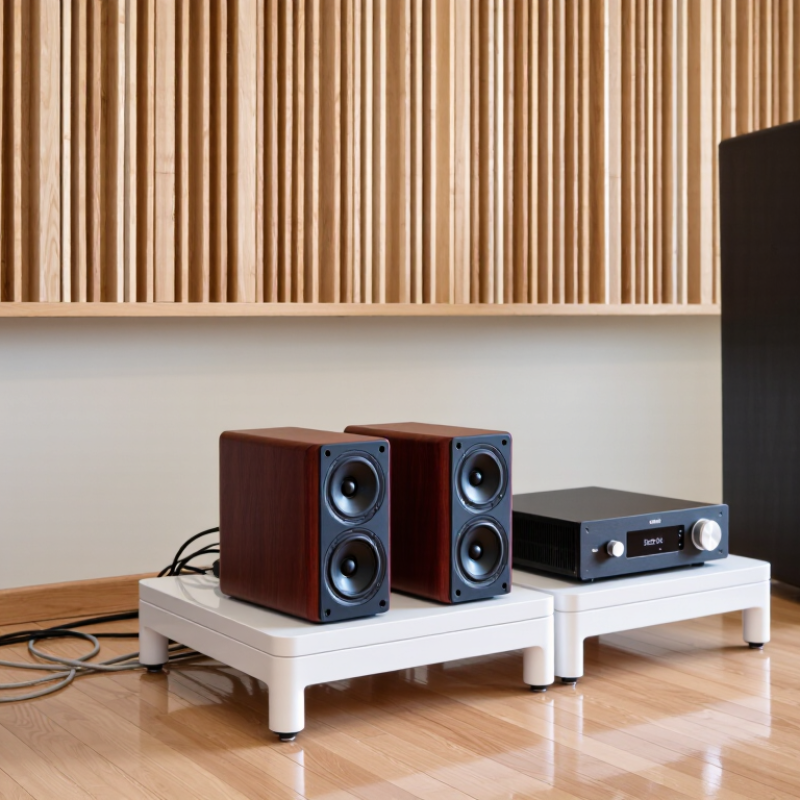
China Best High Fidelity Speakers for Global Buyers?

What Defines Hi-Fi Loudspeakers Under IEC 60268-5 Testing?

For global buyers, “Hi-Fi” should mean verified performance, not a marketing label. IEC 60268-5 specifies methods for measuring loudspeaker characteristics, including frequency response, sensitivity, impedance, distortion, and power handling. It does not prescribe one universal pass score for a speaker to qualify as Hi-Fi. Ask for the test conditions and complete measurement report: a sensitivity figure without distance, voltage, or frequency range is hard to compare. A smooth response matters, but it is not the whole story.

Room conditions matter too. EBU Tech 3276 recommends a reverberation time of 0.2–0.4 seconds from 200 Hz to 4 kHz for reference listening rooms. A speaker measured in an anechoic setup may behave differently beside a bare wall or on a hard floor. Flat curves can still sound thin in a reflective room; real rooms complicate neat specifications. Compare left and right speakers, check distortion at the intended listening level, and review off-axis response where available.

Tips: Request IEC 60268-5 test data, including measurement setup and uncertainty. Match impedance to the amplifier, then audition at a realistic volume. Small details count.

Which Chinese Speaker Makers Serve Global Markets and Product Tiers?

Chinese speaker makers serving global buyers span several distinct tiers. Large export-oriented factories often handle OEM production, repeat orders, and broad model ranges. Specialist workshops may focus on stereo systems, carefully matched drivers, or cabinet finishing. Smaller engineering-led suppliers can offer customization, but buyers should verify their production capacity and testing process. These categories overlap. That is worth remembering.

The market is growing, but market size does not prove sound quality. Grand View Research estimated the global loudspeaker market at USD 6.7 billion in 2023 and forecast a 5.6% compound annual growth rate from 2024 to 2030. For buyers, the practical question is which supplier can document performance at the intended price. Request frequency-response measurements, distortion data, and sample units. Listen at realistic room levels. A polished showroom demo can hide weaknesses in bass control or vocal clarity.

Tips: Match the supplier tier to the job. For a premium home system, check driver consistency, crossover design, and cabinet resonance. For commercial or multi-unit orders, ask about batch testing, spare parts, and delivery capacity. Compare specifications under the same test conditions. If a measurement is missing, ask why.

China’s High-Fidelity Speaker Market: A Guide to the Audible Spectrum

Frequency coverage is one useful comparison point for global buyers evaluating speaker products across price tiers. The bands below are approximate listening-spectrum divisions, not performance claims for any maker or product.

Human hearing is commonly described as spanning roughly 20 Hz to 20 kHz, though the range varies by listener. Frequency response alone does not determine sound quality; buyers should also compare sensitivity, distortion, dispersion, and listening tests.

How Do Frequency Response, Sensitivity, and Impedance Shape Performance?

Frequency response shows how evenly a speaker reproduces low, middle, and high notes. A published range, such as 40 Hz to 20 kHz, tells little without tolerance limits and measurement conditions. A bass note that sounds full in a small showroom may weaken in a larger living room. Check response curves, not just headline figures. Small dips and peaks can change vocal clarity and cymbal brightness.

Sensitivity indicates how much sound a speaker produces from a given input. Higher sensitivity can mean greater output from the same amplifier, but confirm how it was measured. A 2.83-volt test equals one watt only with an 8-ohm load. Impedance also changes across frequencies, so a speaker rated at 8 ohms may dip lower in use. That matters when pairing it with an amplifier, especially at higher listening levels. Ask for impedance curves and tested specifications from the actual model.

Real rooms complicate comparisons. I would not choose by one number alone; that shortcut is tempting, but often misleading.

What Do AES2-2012 Measurement Methods Reveal About Speaker Performance?

For global buyers, AES2-2012 offers a more consistent way to assess professional loudspeaker drive units. Its measurement methods can help interpret impedance, frequency response, sensitivity, resonance, and distortion under specified test conditions. A response curve may show a narrow peak that colors vocals, or a gradual roll-off that softens high notes. But the graph alone cannot describe the complete speaker. Check the test level, frequency range, mounting conditions, and whether results cover a driver or a finished system. Small setup changes matter. Numbers need context.

When comparing products, request measurement reports with clear units and test conditions. Sensitivity figures, for example, are hard to compare if distance or input power differs. Power-handling claims also need a stated test signal and duration. AES2-2012 results can support a technical comparison, but they do not predict every listening room. Reflections from a bare wall, cabinet design, and crossover choices all affect what reaches the listener. Even careful measurements leave a gap: music is not a steady test signal, and listeners differ. A tidy graph is reassuring, perhaps too reassuring. Ask how the published data relates to the assembled speaker you will actually use.

China Best High Fidelity Speakers for Global Buyers? — What Do AES2-2012 Measurement Methods Reveal About Speaker Performance?

AES2-2012 provides standardized methods for measuring and specifying professional loudspeaker drive units. It supports consistent, comparable reporting; it is not a product ranking or a guarantee of sound quality. The table below describes measurement categories and how to interpret them, rather than presenting unverified results for specific products.

Measurement Dimension What Is Reported What It Can Reveal What Buyers Should Check
Frequency response Sound-pressure level across frequency, measured under stated test conditions. Shows the output trend over the measured frequency range and highlights peaks, dips, or limited bandwidth. Compare results only when measurement conditions, frequency range, smoothing, and reference level are clearly stated. A drive-unit response is not the same as the response of a finished speaker in a room.
Sensitivity Sound-pressure level for a specified electrical input and measurement distance or reference condition. Indicates how much acoustic output is produced for the stated input under the stated conditions. Check the input convention, distance, frequency range, and whether the figure is an average or a value at a selected frequency. Numbers measured under different conditions may not be directly comparable.
Electrical impedance Impedance as a function of frequency, rather than a single nominal value alone. Shows how the electrical load varies with frequency and can help assess amplifier compatibility. Review the impedance curve and the manufacturer’s stated nominal rating. A nominal impedance value does not describe every point on the curve.
Harmonic distortion Distortion components measured at stated frequencies and sound-pressure or input levels. Shows how non-linear output changes with frequency and operating level in the test setup. Compare distortion figures only at matching frequencies, output levels, and measurement conditions. A single percentage without those details is incomplete.
Power handling A power-handling result obtained using the specified test signal and procedure. Provides information about the drive unit’s ability to withstand the defined test, not an unconditional guarantee of safe operation in every system. Check the test signal, duration, stated rating, enclosure, crossover, and operating conditions. Power ratings from different procedures may not be equivalent.
Directional response Output measured at multiple angles, typically presented as polar data or related coverage information. Shows how sound output changes away from the on-axis direction and helps describe coverage behavior. Use angle-based data across relevant frequencies when evaluating room coverage. Directional response is a useful system-level consideration and should not be inferred from a single on-axis curve.
Test conditions and traceability Measurement setup, environmental conditions, test signal, reference settings, and equipment or procedure details. Establishes whether reported figures can be interpreted and compared meaningfully. Request complete measurement documentation. AES2-2012 helps standardize measurement and specification; comparable claims still depend on transparent reporting and matching conditions.

How Should Buyers Match Room Size, Amplifier Power, and Certifications?

Room size is not a speaker-size contest. Start with listening distance, ceiling height, and the room’s bass response. ITU-R Recommendation BS.1116-3 gives a 0.2–0.4-second reverberation-time range for critical listening rooms across much of the midrange. Treat it as a useful reference, not a universal home-room prescription. Small rooms need restraint. At a seat three metres away, direct sound loses roughly 9.5 dB compared with sound measured one metre away in free-field conditions. Measure from the listening position, and check for bass buildup near walls. Curtains may soften reflections, but rarely fix low-frequency peaks.

Match an amplifier to speaker sensitivity and impedance, not just the largest wattage on its label. Check continuous output at the speaker’s nominal impedance, plus stability if impedance dips lower. Allow headroom for musical peaks; average listening level alone can mislead. IEC 60268-5 sets measurement methods for loudspeakers, helping buyers compare specifications on a consistent basis. Still, specifications cannot predict every room. For export purchases, ask for test documents tied to the exact model and destination market. IEC 62368-1 covers safety requirements for audio and video equipment, while required conformity marks vary by market. Certification logos are not interchangeable. Verify the paperwork.