
Choosing a hotel door lock is no longer a simple hardware decision. It affects guest confidence, staff efficiency, maintenance costs, and emergency response.
A reliable Hotel Card Lock should work smoothly at midnight, after a long journey, and during busy check-in periods. It must also handle repeated use, magnetic interference, battery changes, and occasional user error. Small details matter. A loose reader. A weak latch. A delayed card response.
Hotel technology consultant Robert Cole captures this concern with a practical observation: “Guest trust begins at the door.” His point is easy to overlook. Guests may never see a property’s server room, but they notice the lock immediately. It is their first daily interaction with hotel security.
This guide reviews seven leading hotel card lock systems for global buyers. The comparison considers access reliability, card compatibility, installation demands, software integration, energy use, support quality, and long-term value. Not every impressive system suits every property. A luxury resort may prioritize mobile access and design, while a compact business hotel may need simple operation and affordable replacement parts.
There are trade-offs.
Some systems offer advanced dashboards but require stronger technical support. Others are easier to deploy yet provide fewer reporting features. Regional service networks can also vary considerably. That uncomfortable detail deserves attention.
The best choice is not always the most expensive lock. It is the system that fits the building, staff capability, guest profile, and maintenance plan. This overview aims to make that decision clearer, while recognizing that no access system is completely foolproof.
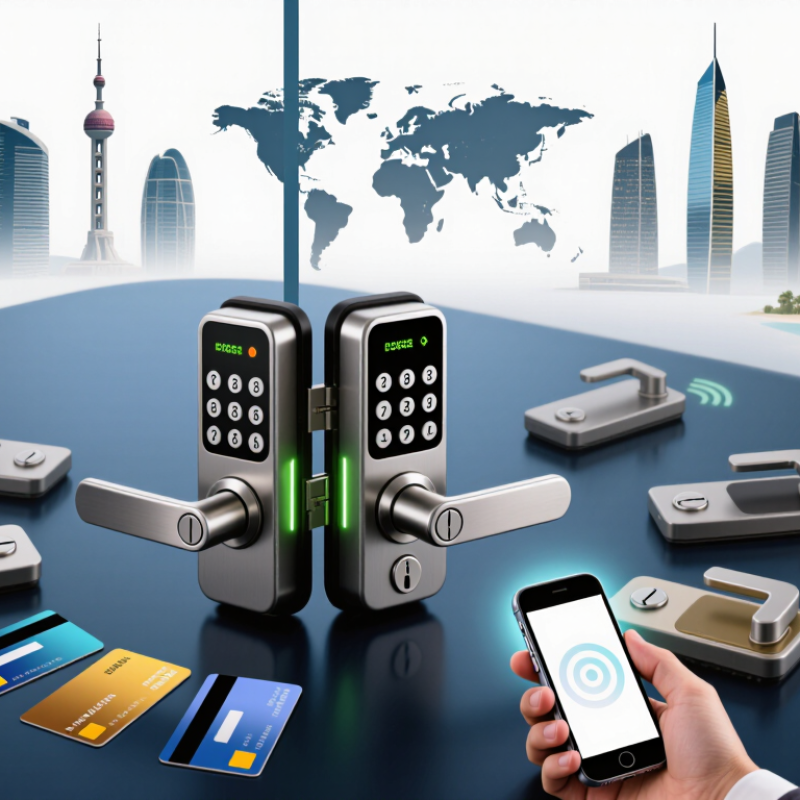
Hotel door security now spans seven practical card-lock types, grouped by RFID, NFC, magnetic stripe, and BLE. Magnetic-stripe locks remain familiar and inexpensive, but cards can demagnetize near phones, wallets, or electrical equipment. Low-frequency RFID locks use 125 kHz credentials and perform reliably through basic plastic cards. They suit properties needing simple access control and long battery life.
High-frequency RFID locks operate at 13.56 MHz and support stronger encryption. NFC locks use the same frequency family, allowing compatible smartphones or cards to communicate at close range. The distinction matters: NFC is a communication standard, while RFID describes a wider identification method.
Dual-interface RFID cards combine convenience with a physical backup. BLE locks use smartphones as digital keys, reducing card handling but requiring battery management and dependable mobile connectivity. Hybrid RFID-BLE locks offer both options. Practical, but more complex.
MarketsandMarkets’ 2024 RFID report estimates the RFID market will grow from 14.5 billion dollars in 2023 to 40.9 billion dollars by 2030. Grand View Research’s 2024 smart-lock analysis forecasts a 19.6% compound annual growth rate through 2030. These figures show strong adoption, not automatic suitability.
In coastal hotels, test corrosion resistance and wet-card performance. In large buildings, check elevator compatibility and offline operation. BLE can fail when a guest’s phone battery dies. Magnetic stripe can fail earlier than expected. A perfect shortlist is unrealistic. Procurement teams should compare encryption, audit logs, emergency entry, replacement cost, and local maintenance skills before selecting one of the seven types.
For global hotel buyers, a 13.56 MHz RFID lock should be evaluated beyond read distance. ISO/IEC 14443 defines contactless communication between cards and readers. It does not automatically guarantee strong security. A reliable system should support mutual authentication, encrypted data exchange, and carefully managed cryptographic keys.
During practical evaluations, test the lock beside an elevator, metal door frame, and crowded lobby. These locations can expose weak antennas or inconsistent reading. Check whether a guest card opens only the assigned room. Also test early checkout, lost-card cancellation, and power interruption. Offline operation matters when a network connection fails.
Compare card types, reader response time, audit records, and credential expiry controls. Key diversification is valuable because one exposed credential should not endanger every room. Secure messaging can reduce the risk of copied transaction data. However, security depends on configuration and staff procedures, not frequency alone. A perfect protocol can be weakened by shared administrator passwords.
Ask for documented ISO/IEC 14443 compatibility, penetration-test evidence, firmware update procedures, and access logs. Review who can issue replacement cards and how quickly old credentials become invalid. Avoid accepting vague claims such as “military-grade” protection. They sound impressive but reveal little. The uncomfortable part is operational discipline. Even a well-designed lock can fail when emergency cards remain active too long or audit logs are never reviewed.
Battery performance should guide every hotel card lock purchase. The seven strongest options include RFID, MIFARE-compatible, mobile-enabled, keypad, hybrid, offline, and networked systems. Each design needs different power planning. A busy entrance may drain batteries faster than a quiet guestroom corridor.
The IEA’s Global EV Outlook 2024 reported a 14% drop in lithium-ion battery pack prices during 2023. Lower prices do not guarantee longer lock operation. Alkaline batteries remain practical for many properties, while lithium cells can perform better in cold environments. Check the lock’s tested voltage range, low-battery warning, and emergency power method. A dependable system should support a 2–4-year service interval under stated usage conditions. That claim needs proof, not optimism. The 2024 Hotel Technology Study from Hospitality Technology also highlights growing investment in connected guest technologies, which can increase battery demand through wireless communication.
Tips: Request field-test data from hotels with similar door traffic. Test 50 doors before full deployment. Record voltage, opening counts, temperature, and warning time. Replace batteries by measured condition, not calendar habit alone. Still, calendar schedules protect properties when monitoring is inconsistent.
For global buyers, compare battery chemistry, local availability, recycling procedures, and technician access. Confirm performance under humidity and temperature changes. Standards such as ANSI/BHMA A156.25 and UL 294 can support safer evaluation, but certification does not replace site testing. I would be cautious about promising four years everywhere. High-turnover rooms, repeated card errors, and weak network settings can shorten that interval. Good procurement leaves room for this uncomfortable possibility.
Choosing the best hotel card lock system requires more than comparing prices. Global buyers should examine audit logs, encryption, mobile keys, and offline access capacity. In real property evaluations, audit logs often reveal operational weaknesses. They should record entry time, user identity, door number, and failed attempts. Logs should also show emergency openings and administrator changes. Clear timestamps matter during guest disputes or staff investigations.
Encryption protects card data, mobile credentials, and communication between locks and management software. Ask whether data is protected during storage and transmission. Request details about key rotation, administrator permissions, and account recovery. Strong controls are useful only when staff can manage them correctly. Complex systems may create mistakes. That risk is easy to underestimate.
Mobile keys improve convenience, but they depend on phones, batteries, and network conditions. Check whether guests can receive keys securely and revoke them immediately. Offline access deserves closer testing. Measure how many doors, users, and events each lock can store without connection. Confirm how long the system remains functional offline. Test synchronization after an outage. It may not work perfectly on the first attempt.
Tips: Test a full guest journey before purchasing. Include check-in, room transfer, lost phone, and emergency access. Review logs from a real device, not only a demonstration screen. Ask for documented failure procedures. Keep a controlled backup option for reception staff. Examine supplier support response times across different time zones. A practical trial often exposes limitations that specifications hide.
Comparative procurement benchmark based on four practical criteria: audit-log capability, encryption, mobile-key support, and offline access capacity. Scores are normalized on a 100-point scale from publicly documented feature requirements and typical hospitality deployment capabilities.
Higher scores indicate stronger documented capability. Offline access capacity measures how well a system can continue validating authorized credentials during network interruptions.
7 Best Hotel Card Lock Systems for Global Buyers
Match the seven best systems to hotel scale, region, budget, and compliance needs. Magnetic-stripe locks suit small properties with existing cards and limited budgets. RFID locks offer better durability for busy hotels and humid coastal regions. NFC systems fit properties investing in mobile credentials and contactless guest journeys. Oracle Hospitality and Skift Research reported that 73% of travelers wanted smartphones to accelerate hotel processes, including access and check-in.
BLE mobile locks support premium, low-contact experiences, but weak network coverage can create operational gaps. PIN-based locks work well for villas, serviced apartments, and late arrivals. Offline electronic locks suit remote hotels because they continue operating during internet outages. Cloud-managed systems fit multi-property groups that need centralized permissions, audit trails, and rapid credential changes. They also demand stronger network controls and staff training.
Budget is only one filter. A cheaper retrofit may create higher maintenance costs later. I learned this the hard way. Regional requirements also affect data storage, encryption, accessibility, and emergency procedures. The Verizon 2024 Data Breach Investigations Report found that human involvement appeared in 68% of breaches, making role-based access and staff logs essential. IBM’s 2024 Cost of a Data Breach Report placed the global average breach cost at $4.88 million. Buyers should test door hardware, offline recovery, guest privacy, and audit exports before signing. Fancy dashboards are not enough.
| System | Core Access Technology | Typical Communication | Best Hotel Scale | Regional Suitability | Relative Budget | Security and Compliance Considerations | Main Limitations |
|---|---|---|---|---|---|---|---|
| 1. Contactless RFID Card Lock System | 13.56 MHz contactless credentials, commonly based on ISO/IEC 14443-compatible cards or key fobs | Offline credential validation at the door; optional encoder, handheld programmer, or gateway connection | Boutique hotels, serviced apartments, and mid-size properties seeking a modern replacement for magnetic-stripe locks | Strong global fit where contactless credentials and local service support are available | Medium | Use encrypted or diversified credentials where supported. Confirm door hardware, emergency egress, fire-rating, and accessibility compliance with local authorities. | Cards can be lost or shared; offline locks may not receive access changes immediately without an update process. |
| 2. BLE Mobile-Enabled Lock System | Bluetooth Low Energy smartphone credentials, often supplemented by contactless cards | Bluetooth Low Energy between the phone and lock; cloud or property-system connection for credential issuance | Urban hotels, lifestyle properties, and groups with strong digital check-in or loyalty-app adoption | Well suited to regions with high smartphone usage and reliable mobile connectivity; provide cards or PINs as an alternative | Medium to High | Require secure credential provisioning, account recovery, encryption in transit and at rest, privacy controls, and a documented lost-phone procedure. GDPR or equivalent privacy rules may apply depending on location. | Depends on compatible phones, battery power, app permissions, guest identity workflows, and integration quality. |
| 3. Online Wireless RFID Lock System | Contactless RFID credentials with real-time or near-real-time access management | Wireless gateway network using Wi-Fi, Ethernet, or a low-power radio mesh, depending on the installation | Large city hotels, convention properties, hospitals with guest accommodation, and multi-building resorts | Suitable globally, subject to radio-spectrum rules, network availability, and local electrical requirements | High | Supports faster revocation, audit trails, and centralized administration. Review network segmentation, role-based access, logging retention, vulnerability management, and local data-protection obligations. | Higher installation complexity; wireless coverage, gateways, batteries, and IT support must be maintained. |
| 4. Magnetic-Stripe Card Lock System | Low-coercivity magnetic-stripe cards, generally encoded according to established card-data formats such as ISO/IEC 7811 | Offline card reading with a front-desk encoder or portable programming device | Budget hotels, legacy properties, and projects where existing locks and card-encoding equipment remain serviceable | Still usable in some markets, but less future-proof where contactless access is expected | Low | Keep lock audit logs protected and limit staff permissions. Do not use hotel room cards to store payment-card data; PCI DSS applies to payment environments, not automatically to every hotel access card. | Cards wear out, are vulnerable to magnetic damage, and offer a weaker long-term user experience than contactless alternatives. |
| 5. PIN Keypad and Card Hybrid Lock System | Contactless card plus PIN keypad; some configurations also support mobile credentials | Usually offline at the door, with optional online management through a gateway or controller | Extended-stay hotels, apartments, employee lodging, and properties serving guests without smartphones or cards | Broad international fit, provided keypad accessibility, emergency release, and privacy requirements are addressed | Medium | Use rate-limiting, PIN expiry, tamper detection, secure storage, and separate staff and guest privileges. Check accessibility and fire-egress requirements for the target country. | Visible keypads may reveal wear patterns; PIN sharing and shoulder-surfing require operational controls. |
| 6. Energy-Saving Guest-Room Card System | Room access card combined with a wall-mounted card or credential switch for controlling selected room loads | Door lock is typically offline; energy-control device communicates with the room electrical system | Resorts, large full-service hotels, and properties prioritizing room energy management | Useful worldwide, but electrical installation must follow national wiring codes and local energy regulations | Medium to High | Can reduce unnecessary lighting or HVAC operation when correctly commissioned. Require licensed electrical installation, suitable circuit protection, fire-safety review, and clear privacy policies for occupancy data. | Savings vary by climate, HVAC design, guest behavior, and control logic; incorrect wiring can create safety and comfort problems. |
| 7. Integrated PMS-Connected Access System | RFID, mobile, PIN, or multiple credential types managed through a property-management integration | API, middleware, secure local network, or cloud integration between the lock platform and property-management system | Multi-property groups, high-occupancy hotels, and operations requiring automated check-in, room changes, and immediate revocation | Global potential, but integration availability, hosting location, language support, and local data-transfer rules must be verified | High | Evaluate API authentication, least-privilege access, audit logs, backup procedures, incident response, vendor security documentation, and applicable privacy laws. Use network segmentation between guest systems and corporate IT. | Integration failures can affect check-in and room access; requires coordinated support from hotel operations, IT, and system providers. |